
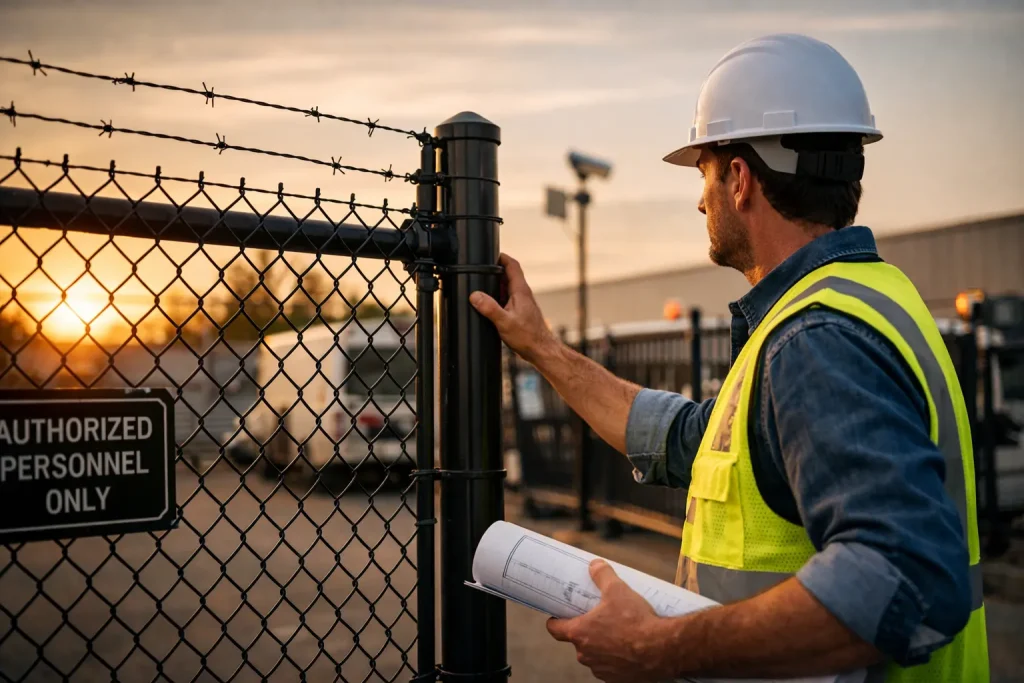
If you have been around construction sites, warehouses, retail builds, schools, or industrial yards long enough, you already know one thing. Commercial fencing is never just about putting up a barrier. It is about liability, security, workflow, insurance compliance, durability, and reputation. It is about doing the job once and doing it right.
At Arvern Iron Works, we approach Commercial Fencing the same way an experienced rider approaches a new horse. You read the terrain. You understand the temperament. You plan for the long ride, not the quick lap around the ring.
In this guide, I am going to walk you through what truly matters in Commercial Fencing. Not brochure talk. Not theory. Practical insight from years of seeing what works, what fails, and what costs owners money when corners get cut.
If you are a property manager, general contractor, facilities director, developer, or business owner, this is for you.
Why Commercial Fencing Is a Different Animal
Residential fencing is about privacy and curb appeal. Commercial Fencing is about performance.
A commercial fence has to:
- Withstand constant use
- Handle vehicle access
- Meet code requirements
- Deter theft and trespassing
- Integrate with access control systems
- Survive weather and abuse
- Maintain professional aesthetics
- Reduce liability exposure
It is infrastructure. Not decoration.
When a commercial fence fails, it does not just look bad. It creates security vulnerabilities, legal exposure, operational disruption, and sometimes serious injury risks.
That is why you do not buy Commercial Fencing the way you buy patio furniture. You engineer it.
Start with Purpose: What Is This Fence Really For?
Before a single post goes in the ground, you need clarity.
Ask yourself:
- Is this for perimeter security?
- Is it for access control?
- Is it to protect inventory?
- Is it to define pedestrian and vehicle zones?
- Is it required for compliance?
- Is it aesthetic branding as much as protection?
Every one of those purposes changes material choice, height, foundation depth, gate configuration, and hardware selection.
For example:
A warehouse storing high value equipment needs anti climb measures, reinforced gates, and potentially crash rated barriers.
A school needs visibility for supervision, smooth edges, secure locking mechanisms, and controlled entry points.
A retail plaza needs security without looking like a correctional facility.
Purpose dictates design. Not the other way around.
The Core Materials in Commercial Fencing
You cannot talk about Commercial Fencing without talking materials. This is where many projects go wrong. People look at initial cost instead of lifecycle cost.
Here are the most common options and when they make sense.
1. Chain Link Fencing
Chain link is the workhorse of commercial perimeters. It is cost effective, durable, and adaptable.
Best for:
- Industrial sites
- Storage yards
- Utility facilities
- Temporary construction enclosures
Key upgrades that matter:
- Heavier gauge wire
- Vinyl coating
- Barbed wire or razor ribbon for high security
- Bottom tension wire
- Privacy slats where needed
Cheap chain link is obvious. It sags, it rusts, it fails at the gates. Properly installed commercial grade chain link holds tension, resists corrosion, and stands straight for years.
2. Ornamental Steel or Iron
When appearance and security both matter, ornamental steel wins.
Best for:
- Corporate campuses
- Schools
- Municipal properties
- High end commercial developments
Advantages:
- High strength
- Custom fabrication options
- Architectural integration
- Long lifespan when properly coated
This is where craftsmanship matters. Weld quality, coating integrity, post depth, anchoring systems. These are not cosmetic details. They determine whether the fence still looks sharp ten years later.
3. Aluminum Fencing
Aluminum is lighter and corrosion resistant. It works well in environments where rust is a concern.
Best for:
- Coastal properties
- Low to medium security sites
- Decorative applications
It is not as strong as steel, so you have to match it carefully to the security requirement.
4. Welded Wire Panels
These provide a cleaner, more modern aesthetic than chain link with increased rigidity.
Best for:
- Schools
- Distribution centers
- Tech campuses
- Parks
They offer visibility and strength with a more contemporary feel.
5. High Security and Anti Climb Systems
When perimeter breaches are not an option, specialized systems come into play.
Features may include:
- Tight mesh spacing
- Vertical pickets
- Curved toppers
- Anti cut materials
- Reinforced gate frames
- Integrated surveillance mounts
This is not the place to experiment. Security fencing requires planning and experience.
The Foundation: Where Commercial Fencing Lives or Dies
You can spot a rushed job by looking at the posts.
Commercial fencing fails most often at ground level.
Common mistakes:
- Shallow post depth
- Inadequate concrete footings
- Poor soil assessment
- No allowance for frost heave
- Improper spacing
Commercial fencing posts must be engineered for:
- Wind load
- Gate weight
- Impact risk
- Soil conditions
- Regional weather patterns
If you are installing large vehicle gates, your post design changes dramatically. If you are in freeze thaw conditions, depth and drainage matter even more.
You do not save money by skimping on foundations. You pay for it later in repairs and downtime.
Gates: The Most Abused Part of Any Commercial Fence
If fencing is infrastructure, gates are moving infrastructure. They take the abuse.
Vehicle gates especially must be designed for:
- Frequency of use
- Vehicle size
- Automation
- Safety compliance
- Access control integration
Swing gates vs slide gates is not just a preference question. It is about space, slope, and usage.
Slide gates are ideal where space is limited or security is higher. Cantilever slide gates eliminate ground track issues but require stronger posts and proper counterbalance design.
Automation adds complexity:
- Motors
- Photo eyes
- Loop detectors
- Keypads
- Card readers
- Remote access systems
If the gate fails, operations stall. That means downtime, frustrated tenants, or security gaps.
Commercial Fencing is as much about mechanical reliability as it is about steel.
Security Integration: Fencing as Part of a Larger System
Modern Commercial Fencing does not stand alone. It integrates.
Consider how fencing connects with:
- Access control systems
- CCTV cameras
- Lighting
- Alarm systems
- Guard stations
- Traffic control devices
Fence design should anticipate:
- Conduit pathways
- Mounting points
- Power supply
- Service access
- Future expansion
A well planned fence supports your security system. A poorly planned one complicates it.
Compliance and Liability
Commercial property owners operate in a world of codes and regulations.
Depending on your location and property type, you may need to comply with:
- Height restrictions
- Visibility requirements
- Pool safety codes
- School security guidelines
- Industrial safety standards
- ADA accessibility rules
- Fire department access clearances
A poorly designed fence can result in:
- Failed inspections
- Fines
- Required tear outs
- Insurance complications
- Lawsuits
Professional Commercial Fencing contractors account for these variables from day one.
Aesthetics Still Matter
Security does not have to look hostile.
Commercial Fencing often defines the public face of a property. It shapes perception.
Consider:
- Powder coating color
- Branding alignment
- Decorative finials
- Integrated signage
- Landscape coordination
An industrial site may want a no nonsense appearance. A corporate headquarters may want refined lines and architectural continuity.
Done properly, fencing enhances property value. Done poorly, it drags it down.
Lifecycle Cost vs Initial Price
This is where experienced decision makers separate themselves.
The cheapest bid is rarely the cheapest fence.
Ask:
- What gauge steel is being used?
- What coating system?
- How are posts anchored?
- What is the warranty?
- Who services the gates?
- What is the expected lifespan?
A fence that costs 15 percent more but lasts twice as long is not expensive. It is smart.
Commercial Fencing should be evaluated over 10 to 20 years, not 12 months.
Maintenance Planning
Every fence requires maintenance. The question is how much.
Plan for:
- Periodic inspections
- Hardware tightening
- Gate alignment checks
- Recoating or touch ups
- Automation servicing
- Vegetation management
Proactive maintenance prevents catastrophic failures.
The goal is controlled upkeep, not emergency repair.
High Traffic Environments: Designing for Reality
Commercial sites are hard on infrastructure.
Forklifts bump posts.
Delivery trucks clip gates.
Snowplows push into fence lines.
Tenants lean materials against panels.
Design accordingly.
Options include:
- Bollards at vulnerable points
- Reinforced corner posts
- Heavier gauge materials
- Protective coatings
- Guard rails in high impact zones
If your fence line borders a busy loading dock, plan for impact.
You build for how the site actually operates, not how it looks on paper.
Temporary vs Permanent Commercial Fencing
Construction sites often require temporary fencing. This is not an afterthought.
Temporary systems must:
- Meet safety standards
- Deter theft
- Provide controlled access
- Withstand wind
- Be reconfigurable
Permanent systems require deeper engineering and long term integration.
Choose accordingly. Mixing the two leads to failure.
Retrofitting Existing Properties
Upgrading an older property brings unique challenges.
Common issues:
- Existing concrete pads
- Utility conflicts
- Uneven grades
- Legacy access systems
- Property line ambiguities
An experienced Commercial Fencing team evaluates the entire site before recommending solutions.
Sometimes a partial replacement is possible.
Sometimes a full system overhaul is more cost effective long term.
The right answer depends on structural integrity, compliance requirements, and operational needs.
Climate Considerations
Weather is not theoretical.
Wind load calculations matter.
Salt exposure matters.
Freeze thaw cycles matter.
UV degradation matters.
In coastal or high moisture environments, corrosion protection is critical.
Powder coating quality, galvanization, and material thickness directly affect durability.
Commercial Fencing must match the environment.
Choosing the Right Commercial Fencing Partner
This is not a weekend handyman project. You want a contractor who understands:
- Fabrication
- Structural loads
- Security planning
- Code compliance
- Gate automation
- Project coordination
- Long term service
Ask about:
- Past commercial projects
- In house fabrication capabilities
- Installation crews
- Service response times
- Warranty coverage
A serious Commercial Fencing contractor does not just install panels. They engineer systems.
Common Mistakes to Avoid
After years in the field, these mistakes show up again and again.
- Choosing price over performance.
- Ignoring soil conditions.
- Underestimating gate usage.
- Skipping security integration planning.
- Forgetting maintenance budgets.
- Not accounting for future expansion.
- Allowing aesthetics to override security needs.
Each one costs money later.
The Long View: Fencing as Asset Protection
Commercial Fencing protects:
- Physical assets
- Intellectual property
- Inventory
- Vehicles
- Equipment
- Employees
- Customers
- Brand reputation
A well designed fence reduces risk.
Reduced risk improves insurance positioning.
Improved positioning lowers long term operational cost.
Security is not an expense. It is an investment in continuity.
When Custom Fabrication Makes the Difference
Off the shelf solutions work in many cases. But commercial properties are rarely perfectly standard.
Custom fabrication allows:
- Precise height adjustments
- Unique layouts
- Architectural integration
- Specialized gate configurations
- Branding elements
- Enhanced security features
Fabrication expertise separates average fencing from tailored infrastructure.
When a project demands precision, customization delivers.
Planning for Growth
Businesses evolve.
Will you expand your yard?
Add buildings?
Change traffic flow?
Upgrade access control?
Design Commercial Fencing with modular thinking.
Future access points.
Expandable gate automation.
Panel systems that allow modification.
Planning now prevents costly rework later.
Final Thoughts: Commercial Fencing Built to Last
Commercial Fencing is not glamorous. It does not get the spotlight like glass facades or interior finishes.
But when it fails, everyone notices.
A properly designed and installed commercial fence works quietly in the background for decades. It protects, controls, defines, and supports operations without drama.
That is the goal.
When you approach Commercial Fencing with seriousness, engineering discipline, and practical experience, you avoid the headaches that come from shortcuts.
You build infrastructure that stands up to weather, traffic, impact, and time.
You protect your property and your reputation.
And you sleep better knowing the perimeter is handled.
If you are evaluating Commercial Fencing for a new project or upgrading an existing property, take the long view. Build it once. Build it right.